Research
Holography
Holography links quantum field theories with many interacting particles to a theory of gravity with one more spatial dimension. Under this link, a hot quantum system can be described by a black hole. This makes black holes a powerful tool for studying strongly interacting matter. Conversely, it also lets quantum field theory teach us about black holes. We use holography to connect black hole physics with chaos, thermalization and transport in quantum systems. Examples include pole-skipping and exact relations between the spectra of black holes. We also look at what thermal correlators can tell us about black hole interiors and singularities.
Selected publications:
- S. Grozdanov, K. Schalm, V. Scopelliti – Phys. Rev. Lett. (2018)
- S. Grozdanov, M. Vrbica – Phys. Rev. Lett. (2024)
- S. Grozdanov, S. Valach, M. Vrbica – JHEP (2026)
Relativistic hydrodynamics and transport
Hydrodynamics describes how energy, momentum and charge flow in a system after it settles down. It works for fluids as different as water, the quark-gluon plasma made in heavy-ion collisions, and plasmas in astrophysics. Even so, basic questions are still open: when the hydrodynamic description works, how it fails and what takes over far from equilibrium. We study the mathematical structure of hydrodynamics and related approaches such as kinetic theory. Our questions include whether the gradient expansion converges, how systems are drawn towards “hydrodynamic attractors” far from equilibrium and what magnetohydrodynamics looks like when it’s built from symmetries. We also look for new exact solutions.
Selected publications:
- S. Grozdanov, P. K. Kovtun, A. O. Starinets, P. Tadić – Phys. Rev. Lett. (2019)
- A. Soloviev – EPJ C (2022)
- M. Bajec, S. Grozdanov, A. Soloviev JHEP (2024)
Black hole photography
In 2019, astronomers released the first image of a black hole, a picture made without a camera or film and built instead from huge amounts of telescope data. Our group is part of project The Photo of a Black Hole: Physics Meets Photography, which asks what it means to “see” something that, by its nature, can’t be seen. Physicists, art historians and artists work together to compare how black holes and photographs can simultaneous reveal and obscure information.
To learn more about the project, its lecture series and its upcoming events, please visit https://blackholephoto.fmf.uni-lj.si/
Members

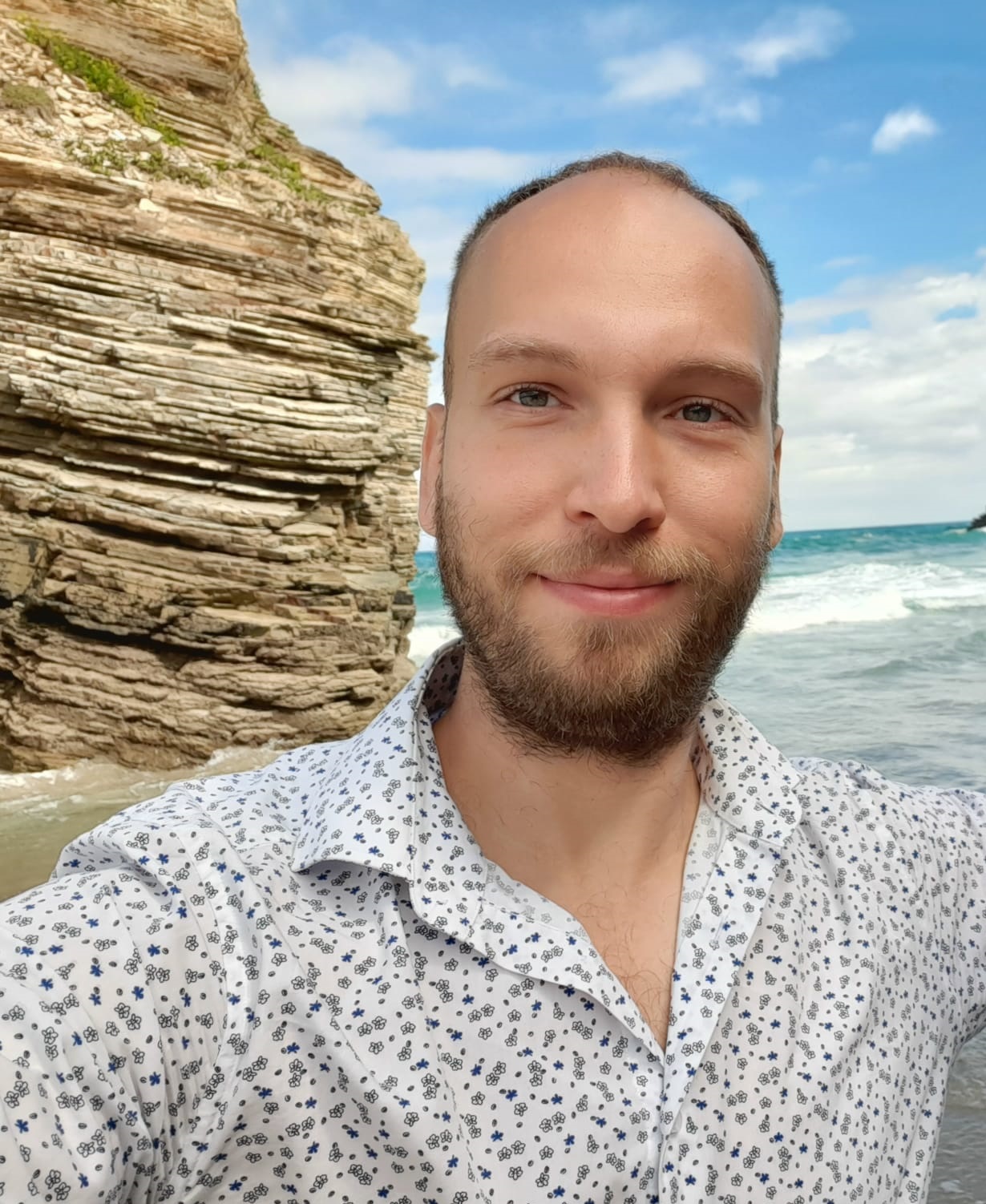



Margherita Eva Conte
- PhD student
Former members


Giorgio Frangi (PhD 2026)
Timotej Lemut (PhD 2025)